
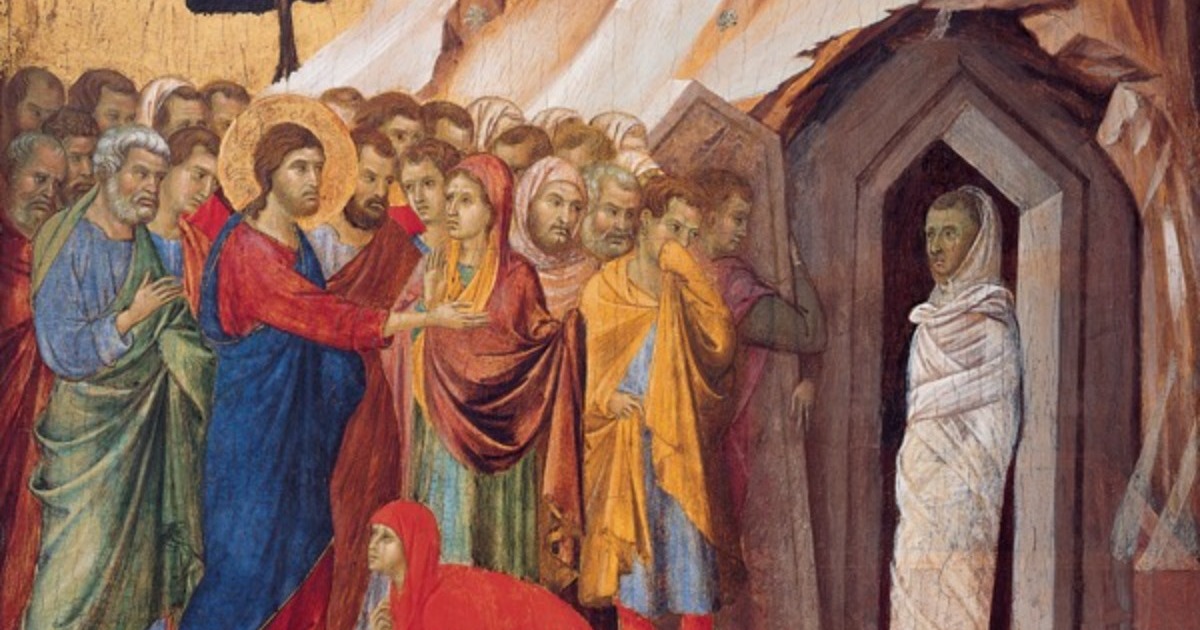
When the large crowd of the Jews learned that Jesus was there, they came, not only on account of him but also to see Lazarus, whom he had raised from the dead. So the chief priests made plans to put Lazarus to death as well, because on account of him many of the Jews were going away and believing in Jesus.
– John 12:9–11
Pär Lagerkvist won the 1951 Nobel Prize in Literature primarily for Barabbas (1950), a tight piece of fiction that follows the criminal after his release in Christ’s stead. A scene that stays with me from this work is when Barabbas happens to meet a certain man with eyes as abysmal as the realm of the dead from which he returned.
Lagerkvist depicts Lazarus as a tragic figure. It is true, men have paid dearly for Christ’s miracles. Simply ask the man born blind. In return for his sight, he is eventually disowned by his family and cast out of the synagogue (John 9:18–34). As for Lazarus, he may have been brought back to life, but this means Jesus is asking him to die twice. God has “appointed for man to die once” (Heb. 9:27; emphasis mine), but apparently that is only a minimum requirement.
Lagerkvist wonders if experiencing the horror of death ruined life for Lazarus, turning his heart into an all-consuming grave, draining the meaning out of everything, for “to those who have been there, nothing else is anything either.” 1 Speculations aside, the Lazarus we find in the Gospel of John does not much resemble the traumatized disciple in Lagerkvist’s fiction. John says that “on account of him many of the Jews were going away and believing in Jesus” (John 12:11); Lazarus “bore witness” (see John 12:17) to his own resurrection and likely took an active role in drawing the crowds to Jerusalem to sing “Hosanna!” for Jesus’s triumphal entry on Palm Sunday (John 12:18). As we have just read, Lazarus was the chief priests’ main target after Jesus Himself (John 12:9–11), which should underscore how prominent he had become. (For instance, the chief priests don’t seem to have regarded Peter as that much of a threat, apparently.)
This plot should also underscore how Lazarus’s resurrection by Jesus differed from Jesus’s resurrection by the Father. Lazarus was raised from the dead, but would die again. The plot to kill him was a real threat. The plot to kill Jesus was also a real threat (and would succeed), but after he died the one time, says Paul, “he will never die again; death no longer has dominion over Him” (Rom. 6:9). John symbolizes this disparity with burial cloths. When Lazarus emerges from his tomb, he is still wrapped in linens (John 11:44), indicating that he is still bound to Death. However, when the disciples discover Jesus’s empty tomb, His burial clothes are set to the side and neatly folded (John 20:1–10). Lazarus died an ordinary death, whereas Jesus by dying defeated Death.
So what did the raising of Lazarus accomplish, if Lazarus would only die again anyway? There are only seven miracles of Jesus reported in the Gospel of John. These become progressively more and more wondrous. Consider, Jesus healed more than one blind man in the Gospels. We recall Blind Bartemaus in the Gospel of Mark (Mark 10:46–52), sitting outside the gates of Jericho, crying out, “Jesus, Son of David, have mercy on me!” All signs indicate that Bartemaus had not always been blind. He asks Jesus to restore something he once had but lost. In John, Jesus heals a man who had never lost his sight because he had never had it. He was born blind. This was Christ’s sixth and penultimate miracle, and it causes a stir, leading to an examination before the Pharisees, because “Never since the world began has it been heard that anyone opened the eyes of a man born blind” (John 9:32). What Jesus has done here is unprecedented, demonstrating He is not another wonderworker like so many prophets in Israel’s history. His exact identity might still be a question at this point, but at least one thing is certain: There has never been one like Him before.
The resurrection of Lazarus is likewise unprecedented. Jesus was not the first man to perform a resurrection miracle. Both Elijah and Elisha raised persons from the dead, but in each case the person had died that same day and had not even been buried or prepared for burial yet (1 Kgs. 17:17–24; 2 Kgs. 4:8–37). Lazarus, on the other hand, had been dead and buried for four days before Jesus arrived at his tomb (John 11:17, 39). At that point, any latent hopes in his resuscitation were gone. The stink of Death had begun to cling to him (John 11:39), which is to say the grave had thoroughly claimed his body, and no one since the world began had ever brought a man from so far back out of Sheol. No wonder the chief priests wanted to reverse the miracle by killing Lazarus! This was Jesus’s seventh and final miracle, His most miraculous miracle.
It conveyed one thing, that this man, Jesus, had authority on earth over Death itself. Authority over Life and Death was a first principle of Old Testament monotheistic theology. Other gods in other mythologies may exercise considerable powers, but always within their limited domains. For example, there are gods of Life but other gods of Death. But Yahweh rules over every domain. The writer of Deuteronomy claims this makes Yahweh exceptional among the gods: “See now that I, even I, am he, and there is no god beside me; I kill and I make alive; I wound and I heal; and there is none that can deliver out of my hand” (Deut. 32:39; cf. 1 Sam. 2:6). The God of the Old Testament brings down and raises up (Ps. 75:5); He gives and takes away (Job 1:21); He makes paths crooked (Lam. 3:9) and straight (Prov. 3:6); He breaks our bones (Lam. 3:4) and mends them (Ps. 51:8). No other miracle signaled Christ’s divinity quite like the raising of Lazarus. Who then is this, the witnesses might have whispered, that even Death obeys Him?
But this stirs a question: If Jesus already had authority over Death, why did He have to die to defeat it? Is Death not already subject to Him? Why did He not simply command from heaven, “Death, be dead!”
God could have killed Death with a nod, as it were. That might have worked, if sin and death didn’t exist except in a purely legal sense, written on a record in a filing cabinet somewhere. But St. Athanasius reminds us that Death is not some external entity. It exists within us; it is “interwoven with the body … as if united to it.”2 The body is where sin and Death live and where they first originated. God is not far away in heaven attempting to restore His creation remotely. By clothing Himself in human flesh, God has taken the fight to its source. If you want to blot out the record of sin, you must do it where that record is written, here in the human being.
So how does God actually defeat Death? Not by fiat, but by overcoming it with His own immortal and divine Life. Because the Word of the Father “was not able to die,” says Athanasius, “for this reason He takes to Himself a body capable of death, in order that it, participating in the Word who is above all, might be sufficient for death on behalf of all.” 3 Christ’s humanity functioned like a vessel that could cross the River Styx, carrying in its hold a secret cargo: Life, capital-L; Life Himself, eternal, immortal. Christ by dying smuggles divine Life into the enemy camp, and thereby defeats Death by death.
So we return to Lazarus. He died twice. But his deaths were not the same. His first death was before the first Easter, in Adam; his second death after Easter, in Christ. Someday, we might ask him how they felt different. But I close now with a gospel irony: Each of us must be a Lazarus, for each of us must also die twice. Each of us will die in the body at some point, perhaps suddenly, perhaps slowly, but inevitably. We ought not fear it (see Heb. 2:14–15). Before the revelation of Christ, the psalmist could lament, “For in death there is no remembrance of you; in Sheol who will give you praise?” (Ps. 6:5). But now the grave no longer separates us from God. Christ has entered Death and filled it with Himself. To die now is to be with Christ (see Phil. 1:23; 2 Cor. 5:8), and then the resurrection.
But there is a second death we must die, the death which puts to death the flesh, the “old man” (Eph. 4:22–24), and nails down its passions on each of our crosses (Matt. 16:24; Mark 8:34; Luke 9:23). This is the death into which we are buried in baptism (Rom. 6:3–4; Col. 2:12), but it is a daily death, a continuous mortification of sin. The first death has various causes: illness, calamity, war, old age. The second death has only one cause: humility, which is shorthand for the imitation of Christ. As Jesus obeyed the Father, so we must obey the Spirit. This is to die a death like Christ’s (see Phil. 2:8), and “if we have died with Christ, we believe that we will also live with him” (Rom. 6:8). So put on Christ, as Christ put on you, so that where Death once lived, Life Himself is now interwoven with our body, as if united to it, to whom belongs glory and dominion forever and ever. Amen.
- Pär Lagerkvist, Barabbas, trans. Alan Blair (Vintage International, 1950), 52.
- Athanasius of Alexandria, On the Incarnation, trans. John Behr, Popular Patristics Series 44B (St Vladimir’s Seminary Press, 2011), 44.
- Athanasius, On the Incarnation, 9.
Blake Adams (MA, Wheaton) is a reader, writer, and independent scholar. He is an editor at Logos, LLC, and Lead Sacristan at Church of the Resurrection.
Join us in All Saints’ Chapel, where we will gather for Morning Prayer at 7:30 a.m. every day of Holy Week 2026. For more information, contact Caleb Karnosh at calebkarnosh@churchrez.org.