
Then Simon Peter, having a sword, drew it and struck the high priest’s servant and cut off his right ear. (The servant’s name was Malchus.) So Jesus said to Peter, “Put your sword into its sheath; shall I not drink the cup that the Father has given me?”
– John 18:10–11
When I was an overeager eighteen year old at Wheaton College who had never had a girlfriend, I tried flirting with my now-wife. Somehow, I thought it would be fun to pretend to pour chocolate milk on her, faking her out at the last second. So I ran towards Sophia, and “faked” her out with the cup. Only … inertia did not fake her out with me. The milk splashed over the cup and drenched her completely. I stood there dumbly and said, “Oops, I didn’t think that one through.” Somehow, that apology was insufficient.
But later, I would make it up to her with a night of stargazing and reciting Psalm 19 under the stars. I think that put me back in her good graces.
Thomas Aquinas wrote, “He properly atones for an offense who offers something which the offended one loves equally, or even more than he detested the offense.” 1
That makes good sense. If you forget an important date with your spouse, you might take her on a date and give her flowers. The gift of reconciliation is lovelier than the offense. It makes reparation by virtue of both dealing with the wrong and offering a beauty that exceeds the ugliness of that wrong.
The atonement of Christ, among its many facets, is a gift of love the Son offers to the Father on our behalf. Acting as our Head—our Representative before the Father—the Son offers a gift of love that is far more pleasing to the Father than our sin is ugly. To understand this, we need to understand how sin damages God’s world. God made the world to reflect his beauty. Creation is, as Jonathan Edwards put it, the communication of the divine excellencies. The light of the stars was meant to preach the eternal Light in which God lives in love. The majesty of a mountain peak is an echo of the vast depth of God’s own being. The virtues that color the most excellent moral exemplars we have are refractions of God’s own fullness and goodness.
Sin, then, is the disruption of God’s self-display in creation. Sin is what happens when creation stops showing what God is like. To love another human is to see the face of God, and so to ruthlessly hate another human is to distort God’s face. And so all have sinned and “lack the glory of God” (Rom. 3:23), as St. Paul says; that is, all have sinned and distort rather than reflect God’s glory into the world. In the absence of adequate reparation of God’s glory, God will display his glory in the judgment of evil. His holy wrath against sinners restores the display of God in light of the situation of sin: God utterly opposes all that defaces the Good, the Beautiful, and the True, and therefore all that defaces his visage in creation.
The atonement, at its heart, is the restoration of God’s visage in creation. It is a reparation offered to the Father by the Son—a gift of Love so beautiful that it compensates for the damage we have wrought in God’s good world. In an act of supreme love for the Father and for humanity, the Son binds all people to himself in the incarnation and becomes humanity’s Head. It is as though humanity were one great body, of which Christ is the Head (see 1 Cor. 11:3).
This gift of Love has two dimensions to it. First, Christ accepts the punishment owed to us in our stead out love for the Father and for us. In the human body of Christ, God condemns sin. We are told by St. Peter that Christ “bore our sins in his body” (1 Pet. 2:24), and by St. Paul that God condemned sin in the flesh of Jesus (Rom. 8:3). Jesus was not himself condemned by the Father, but rather his body was offered up as the place where sinful humanity was condemned. Christ’s flesh is the site in creation where the Father’s righteous opposition to sin was experienced and affirmed as righteous by the Son. His humanity, given over to exile from the Father’s protection, became an icon of the divine exile we all merit.
Second, his divine humanity is the site of superlative divine love displayed in creation. The Son laments the sin of the world as deeply as he does because he loves the Father; as sin distorts the Father’s beauty in creation, the Son laments the distortion of that beauty. As I would be grieved if someone slandered a friend dear to me, so the Son is grieved with sin. Further, the whole course of his life—which is carried in his body and soul, as all of our histories are carried with our bodies and soul—was one of supreme love. Indeed, he loved the Father beyond what is required of a human being. He loved the Father unto death (Phil. 2:8), even though he had no sin such that death would be required of him.
Christ’s humanity, then, stands as the place where our sin was condemned, and where the Father and the undeserving were loved to the uttermost. His humanity is where the display of divine Love and Beauty is fully restored in creation. Divine Love’s righteous opposition to sin can be read from the signs of Christ’s sufferings, and divine Love’s unbounded cherishing of God and humanity is displayed in the signs of Christ’s sorrows and forgiveness. And when he pleads his humanity—his blood—for you and for me, we are forgiven.
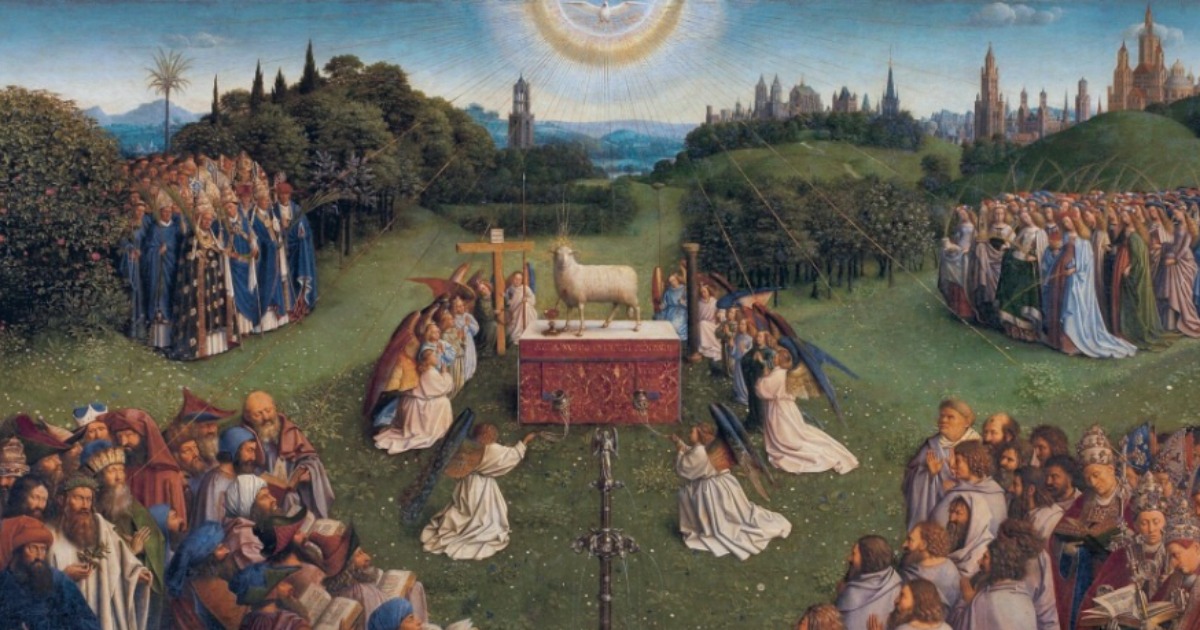
Because the gift of Love the Son offers is infinitely lovelier than sin is ugly, your sins can be forgiven. All compensation God requires has been made by the Son. And so tonight, on this Good Friday, let us behold the Lamb of God who takes away the sin of the world (John 1:29), and trust that it is so.
- Thomas Aquinas, Summa Theologiae, trans. Fathers of the English Dominican Province, 2nd ed. (Burns, Oates & Washburne, 1920), III.Q48.A2.
Sean Luke (MDiv, MA, TEDS) is a parishioner at Church of the Resurrection and an aspiring Anglican theologian. He is published in several journals and runs the channel and podcast Anglican Aesthetics.
Join us in All Saints’ Chapel, where we will gather for Morning Prayer at 7:30 a.m. every day of Holy Week 2026. For more information, contact Caleb Karnosh at calebkarnosh@churchrez.org.