
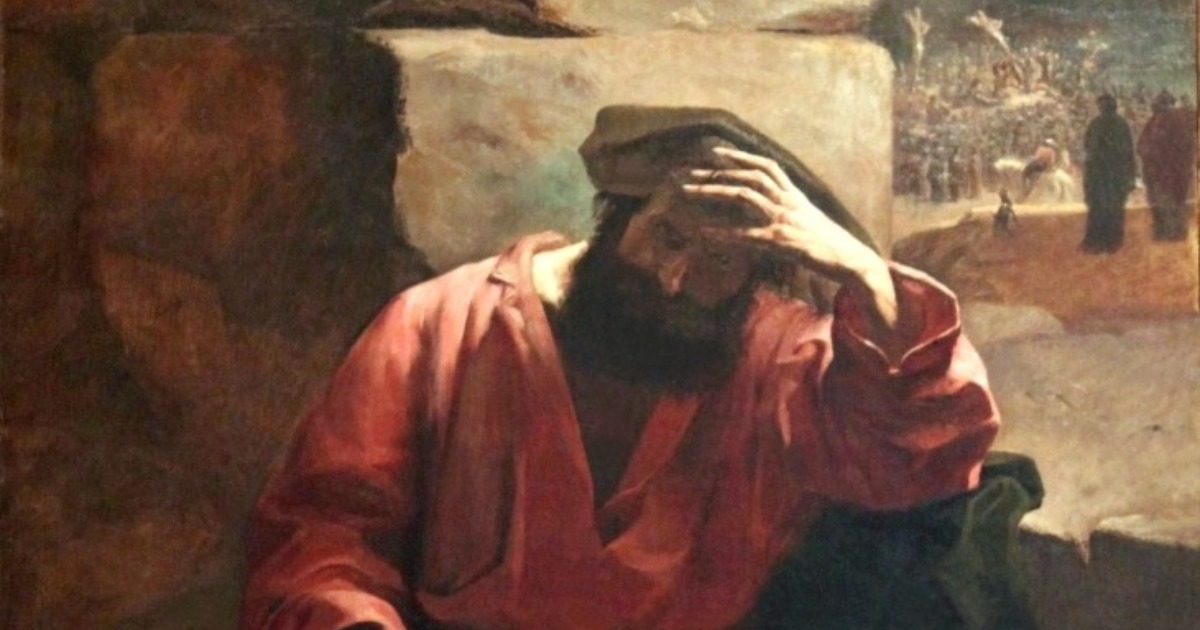
Then one of the twelve, whose name was Judas Iscariot, went to the chief priests and said, “What will you give me if I deliver him over to you?” And they paid him thirty pieces of silver. And from that moment he sought an opportunity to betray him.
– Matthew 26:14–16
“There are two ways, one of life and one of death, and there is a great difference between the two ways.” So begins the ancient catechetical text known as the Didache. This text was used to instruct new converts on what it meant to be a Christian and follow after Jesus. This treatise goes on to describe the two ways: the way of life consisting in the loving of God and neighbor, pursuing a life of righteousness, and self-control. But it also describes the way of death:
It is the way of persecutors of good people, of those who hate truth, love a lie, do not know the reward of righteousness, do not adhere to what is good or to righteous judgement, who are vigilant not for what is good but for what is evil, from whom gentleness and patience are far removed, who love worthless things, pursue a reward, have no mercy for the poor, do not work on behalf of the oppressed, and do not know the One who made them. 1
The Gospel reading for today draws our attention to one of the most famous characters in church history. He is famous because of his direct choice to walk the way of death: Judas Iscariot.
The New Testament doesn’t tell us much about this man. This passage in the Gospel of Matthew is the first time he is mentioned after the listing of the twelve disciples back in chapter 10. His presence in Jesus’s ministry is largely mysterious to us. From everything we can tell, Judas participated in the exorcism of demons; he was there at the feeding of the five thousand; he saw Jesus calm the storm and work miracle after miracle. But at the end of each Gospel, he emerges as the villain, seemingly out of nowhere.
Yet, the Gospel of John does tell us that he was in charge of the group’s moneybag and that he was a thief who did not care about the poor (John 12:6). This description gives us a glimpse into the inner life of a man who, though actively involved in the ministry of Jesus, had frequently succumbed to greed. Maybe Judas realized that the kingdom Jesus was ushering into existence was not the political regime change he had hoped it would be. So he began to look for an easy way out, trying to make a couple bucks in the process.
We can’t know all of what was going on inside of his heart and mind, but this we do know: Judas chose to betray Jesus. What this reveals is that Judas was trying to walk both the way of life and death:. He filled himself with Jesus’s bread while simultaneously stealing from the poor. He outwardly walked as a disciple of Jesus, but inwardly lived as a disciple to his own greed.
“No one can serve two masters” our Lord Jesus teaches in his Sermon on the Mount, “for either he will hate the one and love the other, or he will be devoted to the one and despise the other. You cannot serve God and money” (Matt. 6:24).
Judas is a vivid example of this very teaching. He attempted to walk both ways. He attempted to serve two masters. But in the end, he made the choice to approach the chief priests and ask, “What will you give me if I deliver him over to you?” (Matt. 26:15). Thus, he despised the Lord Jesus.
While Judas is a particular man in a particular place in redemptive history, his story confronts us with the perennial question: Whom will you serve? The Lord Jesus is clear. We cannot serve two masters. We cannot serve God and money (see Matt. 6:24). We cannot serve God and our bellies (see Rom. 16:18). We cannot serve God and our sinful desires (see Rom. 6:1–2).
The season of Lent is a time of prayer, fasting, and self-examination. In this time, we ask the Lord to reveal more clearly our weaknesses and sins. We do this not to feel bad about ourselves, but in order that we may see ourselves more clearly, as the Lord sees us. And this attention to prayer, fasting, and examination is important because just as Satan was after the heart of Judas, to pull him deeper into his greed, so the world, the flesh, and the devil tempt us continually to turn us away from full and complete service to Jesus.
So what do we learn from Judas’s story? How do we walk in the way of life? John Calvin, reflecting on the example of Judas, puts it simply: “Let us, therefore, learn to repent early.” 2 You see, Judas kept his greed hidden from the disciples. When Jesus tells the disciples in this passage that one of them would betray him, they were genuinely shocked (Matt. 26:22). No one seemed to suspect Judas! He kept his sin in the dark, and that sin was nourished there. It grew and eventually overwhelmed him.
The most tragic part of Judas’s story in my mind is that, if he had humbled himself, if he had waited a mere four more days after his betrayal, he could have experienced full and complete forgiveness and healing through Jesus Christ. Irony of ironies, Jesus’s blood washed away the sin of Judas’s blood-money.
The act of regular repentance puts us squarely on the way of life because it keeps our sin in the light. It reminds us that we simply cannot serve two masters. Jesus’s love and forgiveness is waiting for you. The joy of Easter morning is before us, a mere four days away, it so happens. Therefore, let us redeem the time we have (Eph. 5:16) and seek the Lord while he may be found (Isa. 55:6).
Whatever sin you are bringing into Holy Week, the Lord can free you from it. No matter the pain you may be experiencing, the Lord Jesus can heal it. The good news for us today is that Jesus Christ experienced the betrayal of a friend. In and through that betrayal, he accomplished our salvation so that you and I could become the friends of God (John 15:15). He can take your betrayal and transform it into devotion and love of God. In the Name of the Father, and the Son, and the Holy Spirit. Amen.
- The Didache, in The Apostolic Fathers: Greek Texts and English Translations, ed. and trans. Michael Holmes, 3rd ed. (Baker Academic, 2007), 353.
John Calvin, Harmony of the Evangelists, Matthew, Mark, Luke, John 1–11, trans. William Pringle (Baker, 1989), 17:193.
Caleb Karnosh is currently in seminary pursuing a Masters of Pastoral Ministry and serves as the Youth Pastor here at Church of the Resurrection. In his spare time, he loves to go on walks with his wife, Makenna, and read books to his sons, Luca, James, and Rory.
Join us in All Saints’ Chapel, where we will gather for Morning Prayer at 7:30 a.m. every day of Holy Week 2026. For more information, contact Caleb Karnosh at calebkarnosh@churchrez.org.