
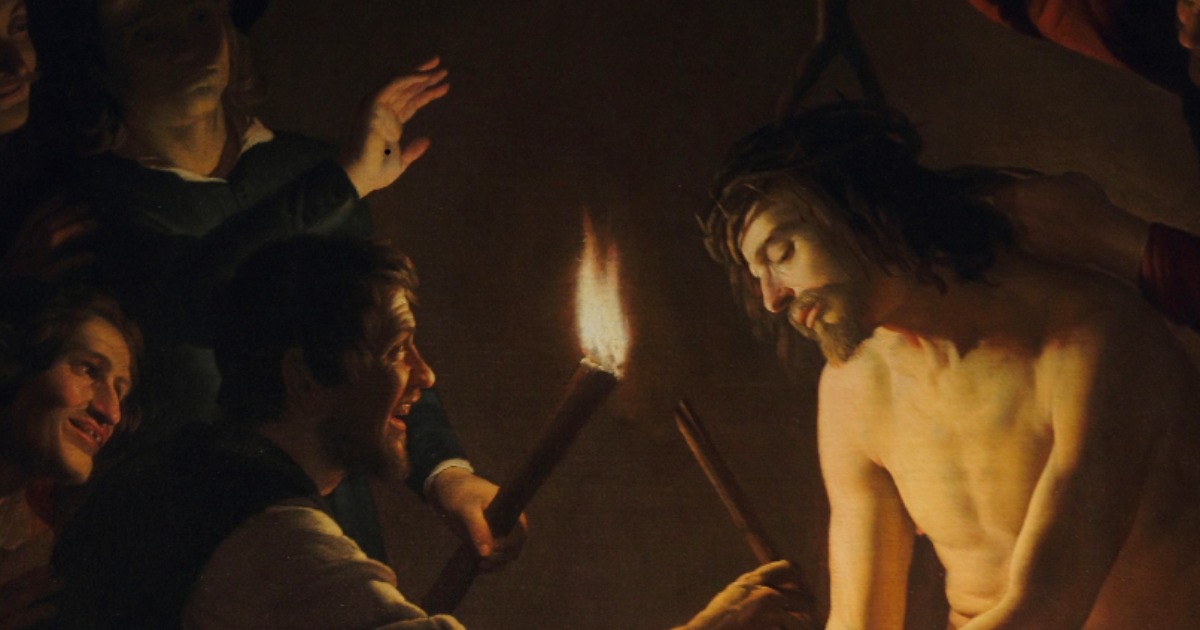
And Jesus cried out and said, “Whoever believes in me, believes not in me but in him who sent me. And whoever sees me sees him who sent me. I have come into the world as light, so that whoever believes in me may not remain in darkness. If anyone hears my words and does not keep them, I do not judge him; for I did not come to judge the world but to save the world. The one who rejects me and does not receive my words has a judge; the word that I have spoken will judge him on the last day. For I have not spoken on my own authority, but the Father who sent me has himself given me a commandment—what to say and what to speak. And I know that his commandment is eternal life. What I say, therefore, I say as the Father has told me.”
– John 12:44–50
Several years ago, I came across a news article about a creative way that some municipalities in the UK were trying to prevent teens from loitering in public places at night. They didn’t hire more police or build fences—they simply put up harsh lighting that highlighted acne. It turns out there’s a reason romantic restaurants use warm, dim lighting. Sometimes we don’t like what the light reveals to us.
The benefit (and sometimes the trouble) of light is that it presents reality to our senses. It helps us to see and relate to the world around us as it really is. And that is precisely why Jesus, who called himself the light of the world (John 8:12), faced so much opposition. When Jesus says that he’s the light of the world, he’s not just saying that he’s a shining example for humanity to follow (though he certainly is that). His ministry was and is a ministry of reality. For those who have eyes to see, he reveals the world as it really is. And sometimes, people don’t like what they see.
Jesus reveals a world that is profoundly broken, where people are in rebellion against God, not only in how we act, but in how we think and in what we desire. A world where even the most fastidious religious types are like dishes that look clean on the outside but are crusty and moldy on the inside (see Matt. 23:27). This profound brokenness of the world is manifested tangibly in the cross itself, where we killed the only perfect man who ever lived.
But Jesus Christ also reveals a glorious kingdom into which those who no longer want to live in darkness are invited to a wedding feast (Matt. 22:1–14). John refers to Jesus’s miracles as signs of this kingdom. They are part of Jesus’s ministry of reality, presenting what the world looks like under the rule of God himself. In this kingdom, there is no shortage of food and no shortage of wine (Isa. 55:1–3). Blind people see, deaf people hear, prisoners of the devil are set free. And the king of this kingdom is Jesus, who for the sake of his love for us and his love for the Father, willingly gave up his body to that same cross so that it could be transformed from a sign of our shame to a sign of his victory, because of the empty tomb that comes after it.
Ultimately, he, Jesus, reveals God himself to us. He says in verse 44: “Whoever believes in me, believes not in me but in him who sent me. And whoever sees me sees him who sent me. I have come into the world as light, so that whoever believes in me may not remain in darkness.”
And what does King Jesus ask of us? He asks to see ourselves and our world as we truly are: broken and in need of salvation. He asks us to see his kingdom as it truly is: good and glorious and free. And he asks us to see God as he really is: as one who loves us and calls us home. Jesus asks us to trust him and to see reality as God sees it.
But in the passage we read, we see two different responses to Jesus’s ministry of reality. The first is unbelief or, to follow the light imagery, spiritual blindness. People didn’t like what the light was showing them, so they chose to close their eyes. For Jesus’s hearers, they were having a hard time making sense of a messiah who dies. Perhaps this was because their vision of God’s kingdom was largely geopolitical: an overthrow of the Roman Empire and a glorious return to the glory days of Israel. They couldn’t accept Jesus’s vision of a kingdom where God reigned in the hearts of his people. Unbelief can take other forms, as well—perhaps as an inability to recognize the destructive power of sin in our lives or to accept that God’s design for us is actually good. Even as believers, we may sometimes find ourselves having moments of blindness where we don’t like what Jesus reveals to us about ourselves or about the world, so we momentarily shut our eyes.
But there’s a second, perhaps even more tragic group. There are some authorities in Jesus’s time who see the light! They actually recognize that Jesus is the messiah they have been waiting for! But when the seed of the gospel falls on the soil of their hearts, it is choked out by two things: fear and desire. They are afraid of the price they will have to pay to follow King Jesus. And they love the glory that comes from other people more than the glory of God’s kingdom. They see that the world is broken, but they love “King Power” and “Queen Wordly Respect” too much to change allegiances. They just can’t bring themselves to take up their crosses and follow Jesus. This is one of the reasons why Jesus says it is so difficult for a rich person to enter the kingdom of God (Matt. 19:24). Wealth and power and comfort can make it hard to let go of the broken world that the light reveals to us.
But the same Light of the world who ministered reality to his disciples in the first century is here with you and with me this very week, and he invites us to receive that same ministry of reality.
Perhaps something has happened to you that has shaken your confidence in Jesus’s words. You’ve experienced something that has caused you to doubt the goodness of God, or you’ve read something that leads you to question the words of Jesus. Jesus invites you to consider the witness of the empty tomb and to believe that he has conquered death. Pray the prayer of the desperate father who came to Jesus and said, “I believe; help my unbelief!” (Mark 9:24).
Or maybe belief isn’t your problem. Maybe you are afraid of what will happen if you finally name out loud the sin you have been hiding. Or if you actually make that decision that God has laid on your heart. Maybe this has been a particularly rough Lent for you, where you’ve become very aware of the power of your desires—maybe this one desire has a tight hold on your heart. Jesus offers you an invitation this week to take up your cross and walk with him to Golgotha. Can you do that this week? Can you trust these words that we read this morning? “I know that his commandment is eternal life” (John 12:50).
Jesus doesn’t invite us to blind faith. He invites us to a faith that sees the world clearly as God sees it. My prayer for all of us this week is that God will renew our spiritual vision by the power of his Holy Spirit. May he open our eyes and our hearts to receive his ministry of reality.
Kevin Sheehan (MDiv, TEDS) has worshipped at Resurrection with his family since 2014 and previously served as Children’s Pastor and Executive Pastor. He currently leads the Enterprise Applications team at Wheaton College.
Join us in All Saints’ Chapel, where we will gather for Morning Prayer at 7:30 a.m. every day of Holy Week 2026. For more information, contact Caleb Karnosh at calebkarnosh@churchrez.org.